Here's what a full day like that looks like, and what ends up on your plate by the end of it.
What's included in a full day
A typical program runs five parts back to back. It starts at a traditional market, watching, and usually joining in on, the morning shop for produce and spices. From there it's a short stop at a rice field to see how Balinese farmers manage water through the Subak system. Then two hands-on cultural stops, making a canang sari offering and watching coconut get pressed into cooking oil, before the cooking class itself: a spice paste built from scratch, several dishes made from it, and then everyone sitting down to eat what they made.
The market visit
This is usually the first stop of the day, and it's worth taking seriously rather than treating as a quick photo op. Balinese markets run early and move fast, vendors laying out chilies, shallots, turmeric, and galangal, locals doing their actual daily shop around you rather than performing for tourists.
Seeing what goes into Balinese cooking before you cook it yourself makes the class easier to follow later. You already know what raw turmeric or galangal looks like, instead of meeting it for the first time already chopped and sitting in a bowl.


Rice fields and the Subak system
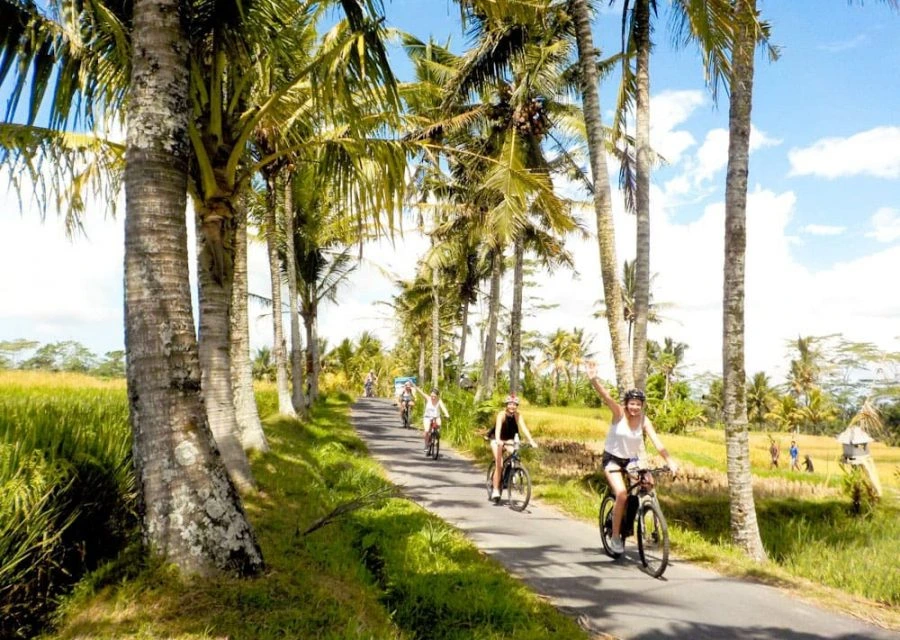
Next is usually a stop at a rice field, mainly to explain Subak, the traditional system Balinese farming communities use to manage irrigation. It's not a minor local custom. Subak is recognized by UNESCO as a World Heritage system, built on the idea that water, land, and community all have to stay in balance together, a philosophy called Tri Hita Karana. Farmers within a subak share water on a rotating basis rather than each person diverting whatever they can grab, which is a big part of why the rice terraces here have kept working for so long.
It's a quick stop, but it's the kind of context that makes the rest of the island make more sense once you understand it.

Making canang sari
Canang sari are the small palm-leaf trays of flowers, rice, and incense you'll see on shrines, ledges, sidewalks, and car dashboards everywhere in Bali. They're a daily offering of thanks, not tied to any special occasion, and most Balinese Hindu households put together a fresh batch every morning.
The class usually has you make one yourself, which sounds simple until you're the one folding palm leaf into a neat little tray and arranging flowers so the whole thing doesn't fall apart. It's a good hands-on way to understand something you'd otherwise just walk past all trip without really registering.
Coconut oil, the traditional way
Somewhere in the middle of the day there's usually a coconut oil demonstration: grating fresh coconut, pressing out the milk, then cooking it down slowly until the oil separates and what's left behind turns into a coconut solid used in other dishes. It's a slower process than most people expect, and a good reminder of how much manual work went into Balinese cooking before anyone had a bottle of oil sitting in the cupboard.

The cooking class itself
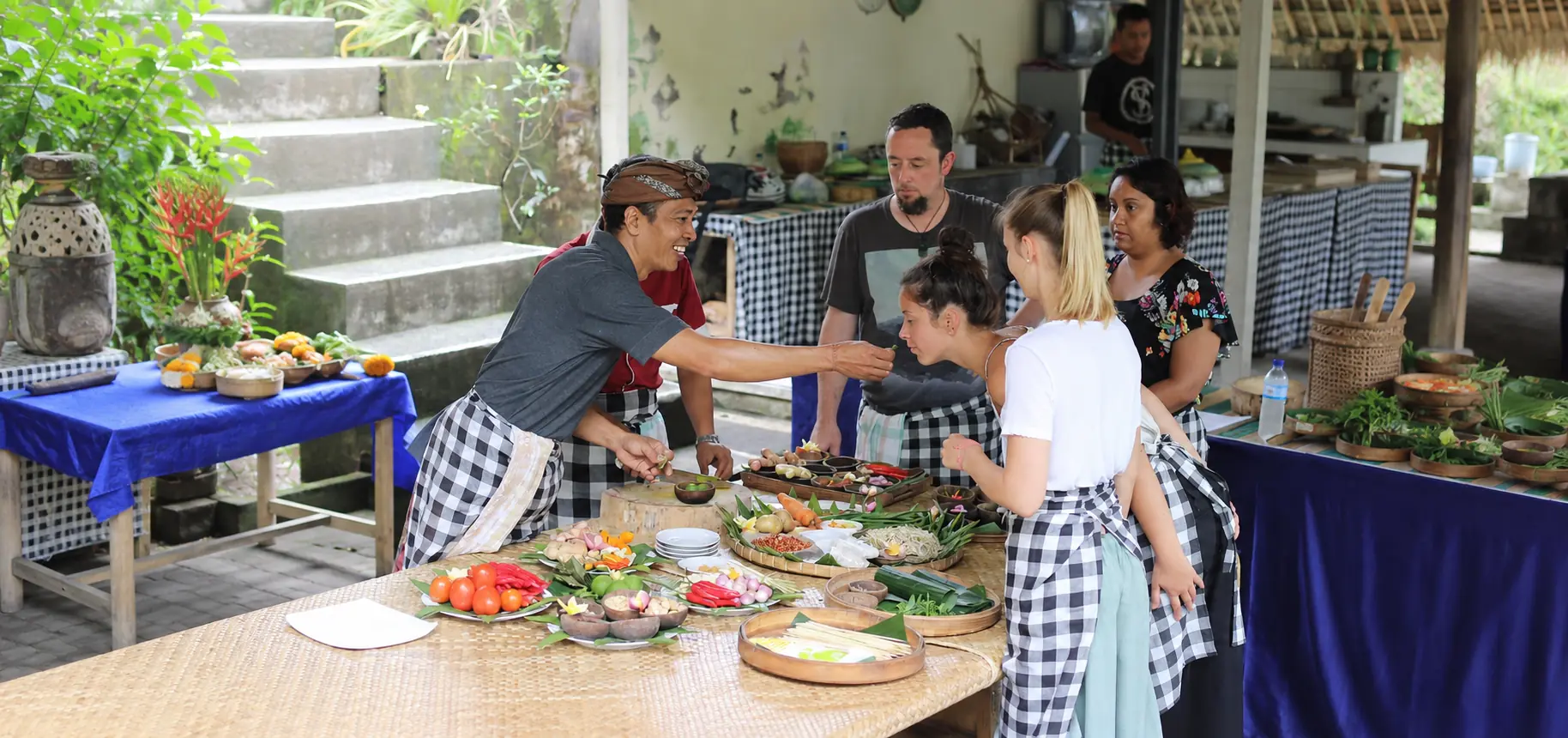
The actual cooking starts with base genep, the spice paste that underpins most Balinese cooking. The name translates to something like complete spice paste, and it's a pounded mix of shallot, garlic, chili, turmeric, and galangal, sometimes with candlenut or coriander seed added depending on who's teaching. Once that base is made, it gets split and worked into several different dishes rather than used for just one, which is basically the logic behind Balinese home cooking: one strong base, several directions from there.
From there you're working through a full menu rather than a single dish: soup, a vegetable salad, rice, satay, a curry, something steamed in banana leaf, and dessert. Everyone sits down and eats what they made at the end, which tends to be the best part of the day.

What you'll actually cook
Most classes run a regular menu with meat and a full vegetarian version alongside it, and both follow the same basic structure: soup, salad, rice, a skewer dish, something steamed, a curry, and dessert.
Regular menu:
- Sup ayam, a light Balinese chicken soup
- Sayur urab, a Balinese vegetable salad tossed with grated coconut and spices
- Nasi putih, steamed rice
- Sate tusuk ayam, chicken satay skewers
- Pepes ikan, fish steamed in banana leaf with spices
- Kari ayam, Balinese chicken curry
- Tempe manis, tempeh fried and coated in sweet soy sauce
- Dadar gulung, a rolled pandan crepe filled with coconut and palm sugar
Vegetarian menu:
- Sup sayur, vegetable soup with mushroom
- Sayur urab, the same vegetable salad
- Nasi putih, steamed rice
- Sate tempe dan tahu, tofu and tempeh satay
- Pepes jamur, mushroom steamed in banana leaf
- Kari tahu tempe, tofu and tempeh curry
- Tempe manis, same as the regular menu
- Dadar gulung, same as the regular menu
If you've got allergies or anything you can't eat, flag it when you book rather than on the day. Most places can work around it, they just need the heads up in advance.


Pickup and timing
Most cooking classes run two sessions a day, morning and afternoon, and pick you up from wherever you're staying. Pickup windows are usually organized by area, something like this:
| Area | Morning session | Afternoon session |
|---|---|---|
| Nusa Dua | 6:00 to 6:30am | 1:00 to 1:30pm |
| Kuta | 6:30 to 7:00am | 1:30 to 2:00pm |
| Sanur | 7:00 to 7:30am | 2:00 to 2:30pm |
| Ubud | 8:00 to 8:30am | 3:00 to 3:30pm |
Pickup from Ubud is commonly free, since it's usually closest to where the class is based. Pickup from further out, Nusa Dua, Kuta, Sanur, may carry a small transport fee, worth confirming when you book.
Good to know
Wear something you don't mind getting a bit of oil or spice paste on. Come hungry, you'll be eating a full meal's worth of what you cook, not just tasting samples. And if there's an open fire or hot oil involved at any point, keep an eye on kids if you've brought them along.
Common questions about Bali cooking classes
Yes. Most classes run a full vegetarian menu alongside the regular one, swapping meat and fish for tofu, tempeh, and mushroom versions of the same dishes.
A full program, including the market visit, rice field, offering making, coconut oil, and the cooking itself, usually takes most of a morning or afternoon, roughly four to five hours including pickup.
No. Classes are built for complete beginners, and a guide walks you through every step of the spice paste and each dish.
The traditional Balinese spice paste, a pounded blend of shallot, garlic, chili, turmeric, and galangal, that forms the base for most Balinese dishes.
Bali's traditional, community-run irrigation system for rice paddies, recognized by UNESCO as a World Heritage system.
Usually, yes. Pickup is organized by area with set time windows, and it's commonly free from areas close to the venue, like Ubud. Worth checking if pickup from further out, like Nusa Dua, Kuta, or Sanur, carries an added cost.