What this guide helps you decide.
- The sanctuary currently lists opening hours of 9:00 AM-6:00 PM and tickets of IDR 130,000 for adults and IDR 100,000 for children.
- Do not bring food or drinks into the forest, feed the monkeys, touch them, or make prolonged direct eye contact.
- Allow around 1.5-2 hours if you want to see the forest, bridges, river area, and temple exteriors without rushing.
- The experience is most rewarding when treated as a sacred forest walk with wildlife, not as a close-contact animal attraction.
Sacred Monkey Forest Ubud is one of the rare Bali attractions where wildlife, culture, and a genuinely atmospheric walk overlap. The monkeys are the obvious headline, but the forest's strongest moments often come from somewhere quieter: mossy stonework, roots wrapping around old paths, river crossings, temple courtyards, and the sudden shift from central Ubud traffic into dense green shade.
The official sanctuary currently describes a 12.5-hectare forest with around 1,260 Balinese long-tailed macaques and three temple areas. These are semi-wild animals, not performers or pets, so a good visit depends less on getting close and more on understanding how to move respectfully through their habitat.
This guide gives you the useful version: current 2026 visitor information, realistic monkey safety, the best time to go, and how to combine the forest with an Ubud Full Day Cultural Tour without turning your day into a rushed checklist.
Why Sacred Monkey Forest Ubud is more than a monkey attraction
The sanctuary is managed by the village of Padangtegal and follows Tri Hita Karana, a Balinese philosophy centered on harmony between people, the spiritual world, and nature. That idea is visible throughout the site: temple spaces sit inside a living forest while macaque groups move through the same landscape used for community rituals and conservation work.
Three sacred areas form part of the sanctuary: Pura Dalem Agung Padangtegal, the Holy Water Temple or Pura Beji, and Pura Prajapati near the village cemetery. Visitors can observe the architecture and surroundings, but some temple areas are reserved for worship and must not be entered casually.
The result feels different from a conventional zoo. There are no cages separating you from the setting, but that freedom comes with responsibility. The macaques choose where they move, and visitors need to give them space.
A living sacred landscape
The temples, cemetery, statues, river, and forest are part of local spiritual life rather than decorative scenery built for tourists.
Semi-wild macaques
The monkeys are accustomed to people but remain unpredictable wild animals. Calm distance creates a better and safer experience.
A real forest walk
Shaded paths, old trees, bridges, carved stone, and changing levels make the sanctuary visually rich even without close monkey encounters.


Sacred Monkey Forest Ubud tickets and opening hours in 2026
The official Monkey Forest website currently publishes the prices and hours below. Operational details can change during Balinese holidays, ceremonies, maintenance, or special events, so check the official website again shortly before visiting.
| Visitor information | Current published detail |
|---|---|
| Opening hours | 9:00 AM-6:00 PM, every day |
| Adult ticket | IDR 130,000 |
| Child ticket | IDR 100,000 |
| Address | Jalan Monkey Forest, Padangtegal, Ubud, Bali 80571 |
| Suggested visit length | Around 1.5-2 hours |
What the visit actually feels like
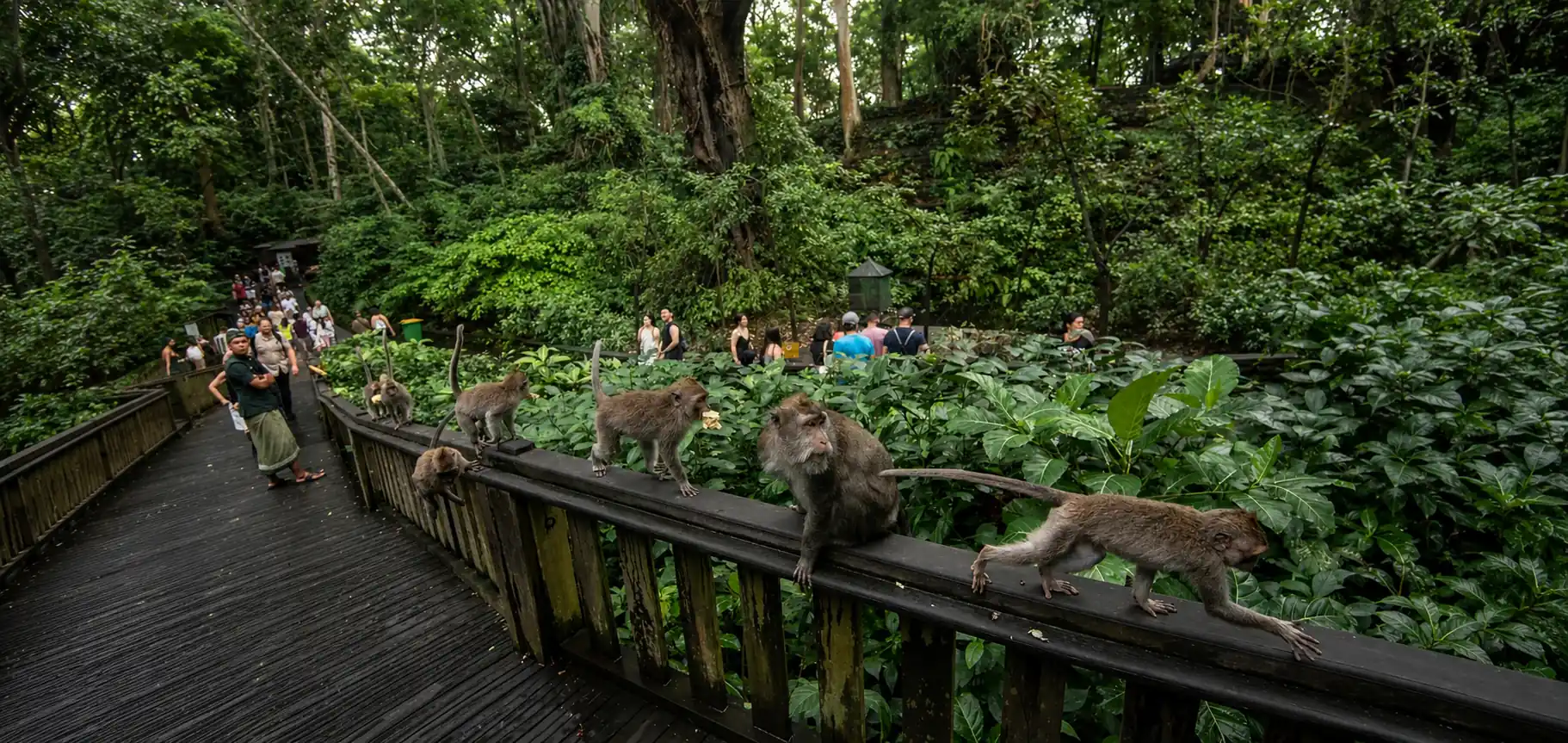
The first few minutes can feel busy near the entrance, especially when tour groups arrive together. Keep walking and the experience becomes more layered. Macaques may sit beside paths, groom one another, carry babies, climb branches, or cross in front of visitors while staff monitor key areas.
Beyond the animals, the forest itself is the main visual experience. Large roots, dense canopy, stone guardians, the Dragon Bridge, river views, wooden paths, and temple exteriors create a moody, cinematic walk. Some paths include steps and damp surfaces, so secure shoes are more useful than fashionable sandals.
You do not need to chase a monkey interaction. The best photographs usually come from observing natural behavior with a little distance and including the forest around the animal.
- Expect macaques to move freely around paths and visitor areas
- Expect shade, humidity, steps, roots, and occasionally slippery surfaces
- Expect some sacred temple zones to be visible but restricted
- Expect staff around the sanctuary who can help if a monkey approaches or takes an item


Monkey safety rules that genuinely matter
The safest strategy is simple: carry as little as possible, keep your hands relaxed, and never encourage contact. According to the sanctuary's official guidelines, visitors should maintain distance, avoid touching the monkeys, avoid direct eye contact, and interact only under staff supervision.
Food and drinks are not allowed inside because they attract attention and can trigger grabbing or aggressive behavior. Do not bring bananas or peanuts. Feeding is handled by sanctuary staff, and peanuts are specifically prohibited for monkey health reasons.
If a monkey jumps onto you, do not run, scream, grab it, or make sudden movements. Stay calm, stand up slowly, walk away gently, and ask nearby staff for help. If you are scratched or bitten, go directly to the sanctuary's first-aid clinic for assessment.
| Do | Do not |
|---|---|
| Keep a respectful distance | Touch, pick up, or play with a monkey |
| Secure glasses, jewelry, phones, and loose items | Display food, drinks, plastic bags, or small objects |
| Stay calm and move slowly | Run, scream, stare, or show threatening body language |
| Ask staff for assistance | Try to retrieve a stolen object by force |
| Supervise children closely | Let children approach or chase macaques |
Best time to visit Monkey Forest Ubud
Arriving close to the 9:00 AM opening is the strongest all-round choice. The paths are cooler, the forest feels calmer, and you can continue into central Ubud before midday traffic builds. Late afternoon can offer softer light, but it may leave less time to explore every path before closing.
Rain changes the mood rather than ruining the visit. The forest becomes greener and quieter, but stone paths and steps can become slippery. During a heavy downpour, wait under cover rather than rushing through the grounds.
| Time | Best for | Trade-off |
|---|---|---|
| 9:00-10:30 AM | Cooler walk, fewer groups, relaxed photography | Requires an earlier start |
| Late morning-midday | Easy to combine with central Ubud | Warmer and often busier |
| After 4:00 PM | Softer light and an atmospheric finish | Less time before closing |
What to wear and bring
Dress for a humid forest walk while remembering that the sanctuary contains active sacred spaces. Comfortable, modest clothing and secure footwear are the best combination. Keep belongings minimal so you spend less time worrying about loose objects.
- Closed shoes or secure sandals with reliable grip
- Light, breathable, respectful clothing
- A small zipped cross-body bag or compact backpack
- Phone or camera secured with a strap
- Hand sanitizer and a light rain layer during wet weather
- No exposed food, drinks, plastic bags, loose jewelry, or dangling accessories
How to get there and what to combine nearby
Monkey Forest sits at the southern end of central Ubud and is walkable from many nearby hotels, restaurants, Ubud Palace, and the Art Market. If you are staying outside central Ubud, a private driver is easier than dealing with limited parking and changing traffic conditions.
A sensible Ubud route combines Monkey Forest with two or three nearby experiences rather than six rushed stops. Browse our guide to what to buy at Ubud Art Market, check the Ubud traditional dance schedule, or compare more ideas in our best places to visit in Ubud guide.
| Suggested time | Stop |
|---|---|
| 9:00 AM | Sacred Monkey Forest Ubud |
| 11:00 AM | Ubud Palace and Ubud Art Market |
| 12:30 PM | Lunch in central Ubud |
| Afternoon | Tegalalang, Tirta Empul, a waterfall, or countryside stop |
| Evening | Traditional Balinese dance performance |
.webp)
Is Sacred Monkey Forest Ubud worth visiting?
Yes for most first-time Ubud visitors, provided you are comfortable around semi-wild animals and willing to follow the rules. It offers more atmosphere and cultural context than a quick roadside monkey stop, and its central location makes it easy to fit into a wider Ubud day.
Skip it if close proximity to monkeys makes you anxious, if your group cannot manage uneven or damp paths, or if you only want a staged animal photo. In that case, spend the time on a temple, rice terrace, eBike route, or waterfall instead.
The right expectation is what makes the difference. Treat Monkey Forest as a sacred nature sanctuary where you happen to observe macaques, not as a place where the animals owe visitors an interaction.
Choose it if
You enjoy wildlife observation, atmospheric forest walks, Balinese culture, photography, and easy central-Ubud sightseeing.
Reconsider it if
Your group is nervous around monkeys, struggles with uneven paths, or expects guaranteed close-contact photos.
Frequently asked questions
The official sanctuary visitor page currently lists tickets at IDR 130,000 for adults and IDR 100,000 for children. Recheck the official website before visiting because prices can change.
The sanctuary currently lists daily opening hours of 9:00 AM to 6:00 PM. Special schedules may apply during ceremonies, holidays, or events.
It is generally manageable when visitors follow official rules: keep your distance, do not touch or feed the monkeys, avoid direct eye contact, secure loose objects, supervise children, and ask staff for help when needed.
No. The official guidelines prohibit visitors from bringing food or drinks into the forest and from feeding the monkeys. Feeding is handled by trained sanctuary staff.
Allow around 1.5-2 hours for a relaxed walk through the forest, bridge and river areas, monkey habitats, and temple exteriors.
Stay calm, do not grab the monkey, stand and move away slowly, and ask sanctuary staff for assistance. If scratched or bitten, visit the on-site first-aid clinic immediately.